The problem
A personal site that switches between five distinct visual themes — Diablo, Arcane, Infernal, Celestial, Terminal — sounds straightforward until you factor in three hard constraints: no flash of unstyled content (FOUC) on any page load or client-side route transition, WCAG AA contrast enforced at build time rather than remembered at commit time, and zero new runtime dependencies beyond what the stack already ships.
Naive solutions break on at least one. Using only Tailwind utility classes
forces re-rendering everything on switch. A CSS data-theme attribute on
<html> solves the FOUC problem on initial load but not on Astro View
Transitions (which replay the <head> hydration). Custom properties in a
<style> tag work everywhere, but validating contrast automatically requires
a build-time hook that doesn’t exist out of the box.
The approach
I designed the engine as six composable layers with a strict dependency order. Each layer owns exactly one concern and exposes a narrow public API.
Layer 1 — Schema (schema.ts)
A single TypeScript type Theme definition covers every visual token: five
background stops, a four-step ink scale, an eight-step primary palette (mapped
to --gold-*), a secondary palette (--purple-*), accent moments, and the
full WoW rarity colour scale. Having a strict schema meant TypeScript caught
incomplete themes at compile time before any runtime code ran.
Layer 2 — Validation (validate.ts)
validateTheme() runs two passes: a structural check (every field is a
non-empty string, every colour is a valid six-digit hex) and a WCAG AA contrast
check (ink.100 on bg.night must be ≥ 4.5:1; primary-400 and secondary-400
on bg.night must be ≥ 3:1 for UI elements). assertValidTheme() wraps this
with a throw so the registry module crashes at import time if a broken theme
ships — no CI step required, the build fails loudly.
Layer 3 — CSS emission (toCss.ts)
toCss(theme) emits a :root { ... } block with every custom property, plus
-rgb channel variants for composing rgba() values. It also emits a
@media (prefers-reduced-motion: reduce) override that zeroes all durations.
This function is pure — same input, same output — making it trivially testable.
Layer 4 — FOUC guard (ssr.ts + inline script)
The guard runs before any stylesheet. It reads localStorage.bakerverse.theme,
resolves the right theme, and injects a <style id="bakerverse-theme"> tag
into <head> before the browser’s first paint. Astro’s set:html renders this
as an inline <script> block — no external file, no render-blocking request.
The same guard is replayed on every View Transition via Astro’s
astro:before-swap event listener to prevent the transition from reverting to
default colours.
Layer 5 — Store & Apply (store.ts + apply.ts)
The store is a plain singleton that wraps localStorage reads/writes with
a pub-sub notifier. applyTheme(id) looks up the theme, calls toCss(),
and swaps the <style id="bakerverse-theme"> content — a single DOM write that
triggers exactly one style recalculation. The useTheme React hook subscribes
to store updates and drives the Navbar switcher UI.
Layer 6 — Editor (encode.ts + serialize.ts)
encodeThemeToHash and decodeThemeFromHash convert a Theme object to and
from a URL-safe base64 string using the encodeURIComponent-then-btoa pattern
to safely handle any non-ASCII characters in metadata strings. Share links are
fully self-describing — pasting the URL into a fresh browser session restores
the exact theme.
serializeTheme emits a valid TypeScript module string (importable,
fully typed, JSDoc header) ready to drop into the themes directory. The file
name is derived from theme.meta.id with non-alphanumeric characters
sanitised out.
The stack choices
Astro 4 hybrid output was already the site adapter; using its set:html
directive for the FOUC guard avoided any additional framework complexity.
Astro’s View Transitions integration was the trickiest piece — the guard had to
re-run on astro:before-swap because View Transitions replay <head> hydration
in a way that wipes inline style content.
CSS custom properties were the obvious carrier for runtime token swaps.
The key insight was that the property names (--gold-400, --bg-night)
never change between themes — only the values do. This means every component
stays untouched; only the :root block swaps. No component code was modified
during the entire theming implementation.
TypeScript strict mode throughout. No any, no // @ts-ignore. The
schema type propagates all the way from theme definition to the editor UI, so
a missing property is a compile error before it ever reaches the browser.
Vitest for the pure utility functions. The encode/decode round-trip tests
and the serialize tests give confidence that share links and exported files
are always valid. Running pnpm test takes under two seconds.
Five themes, one site
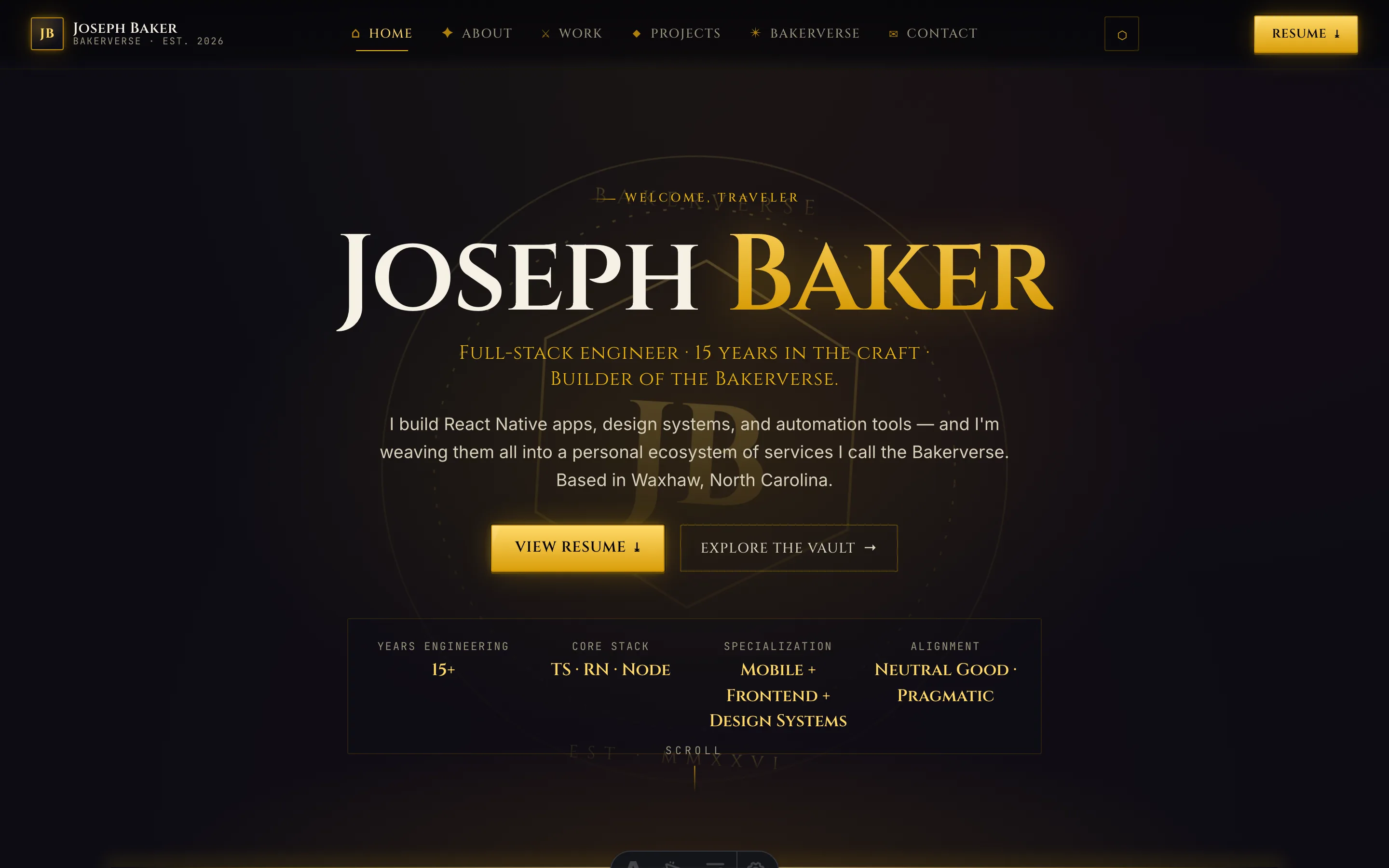
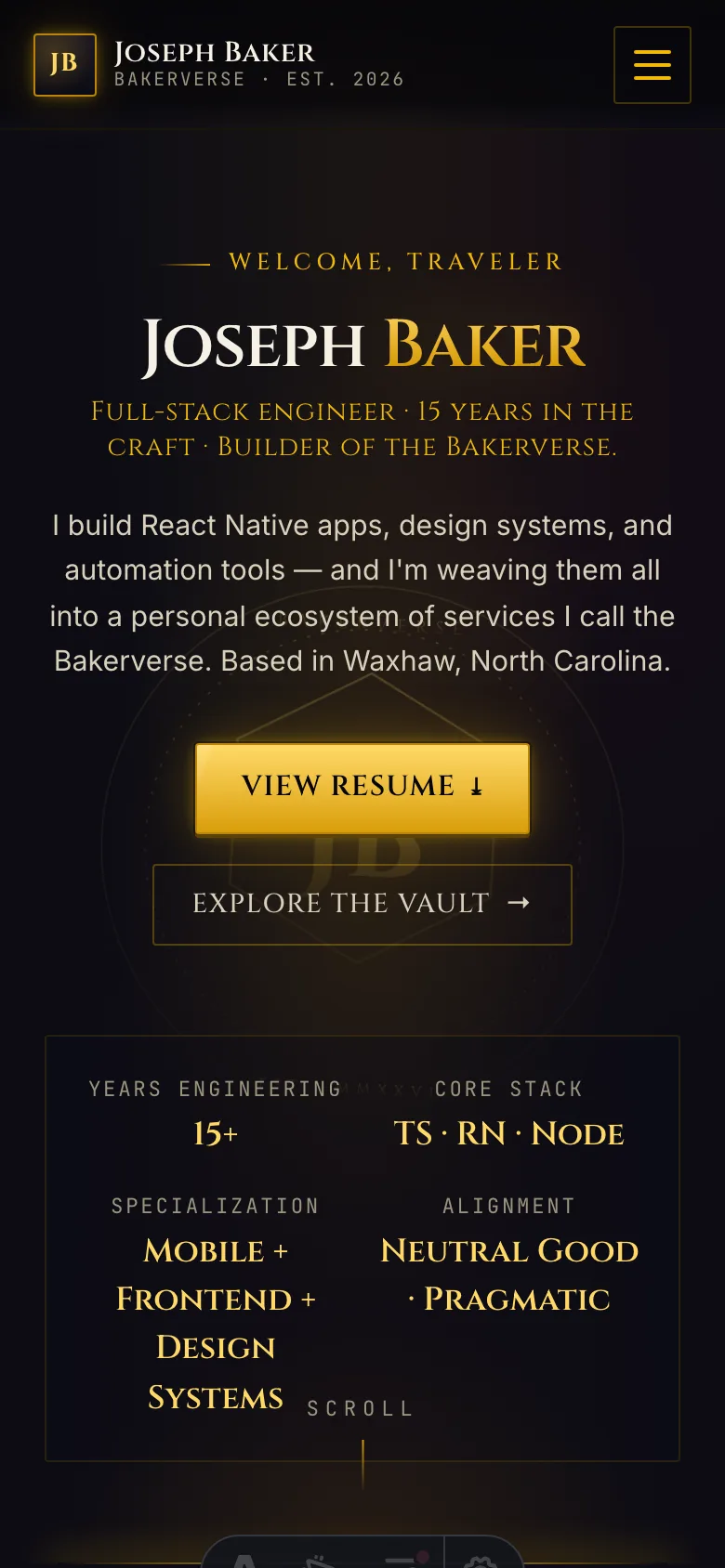
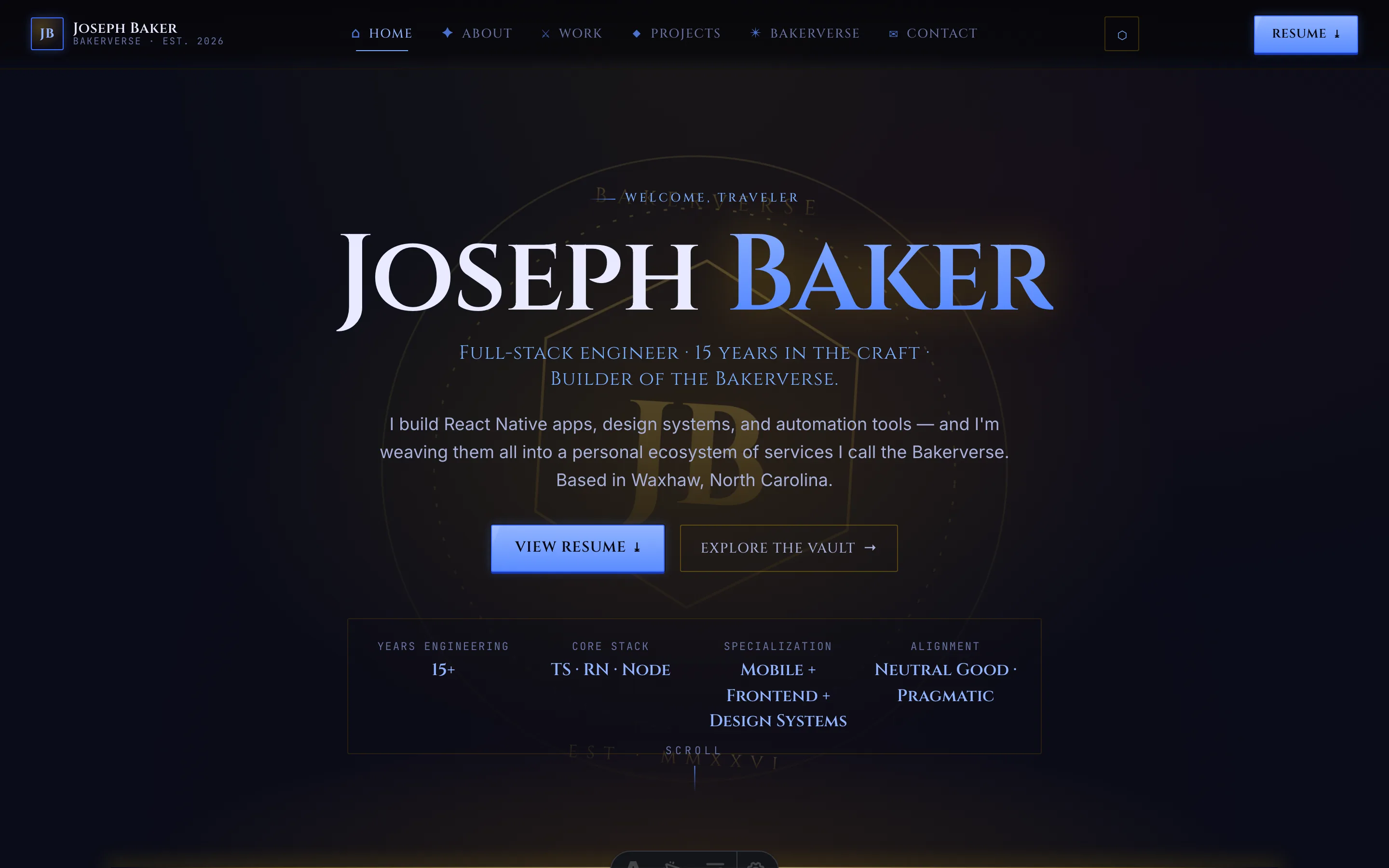
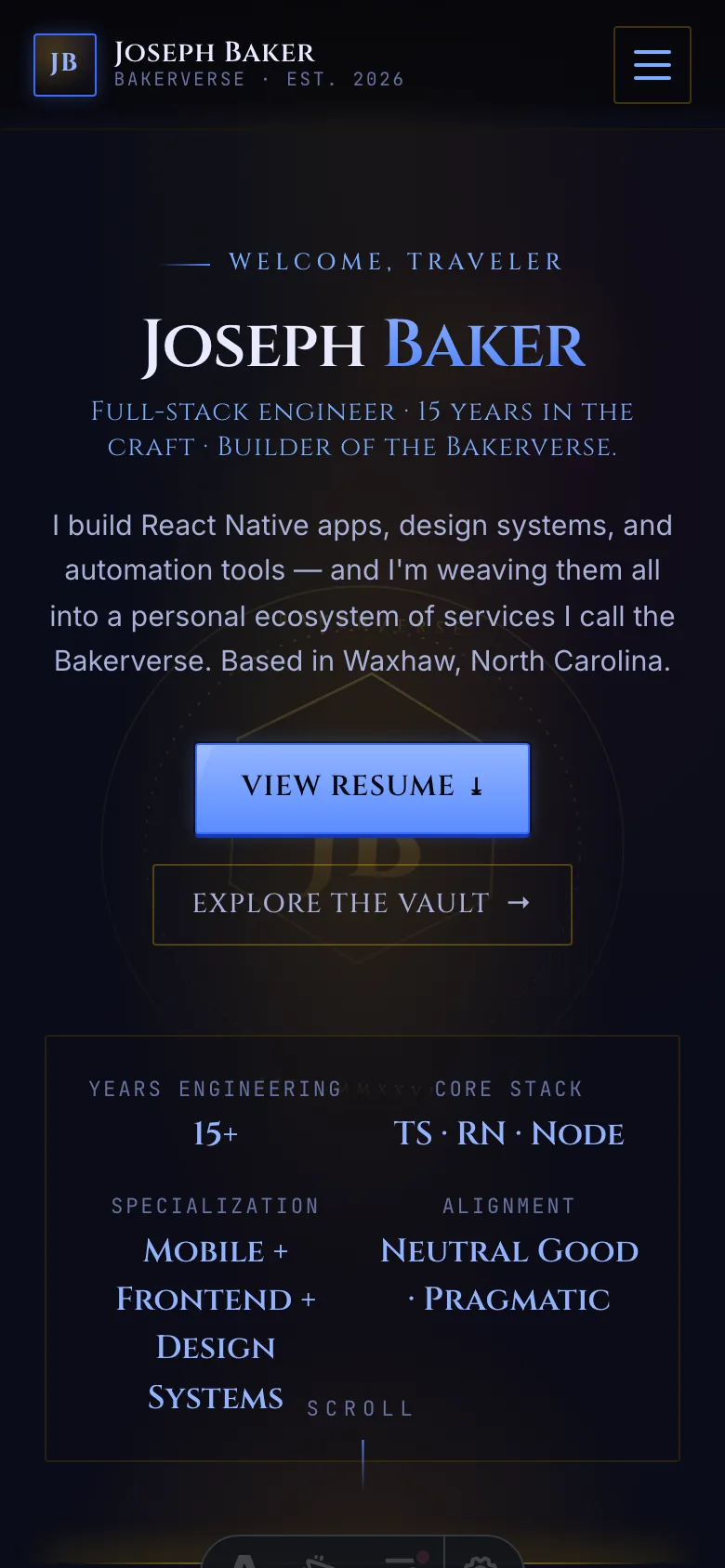
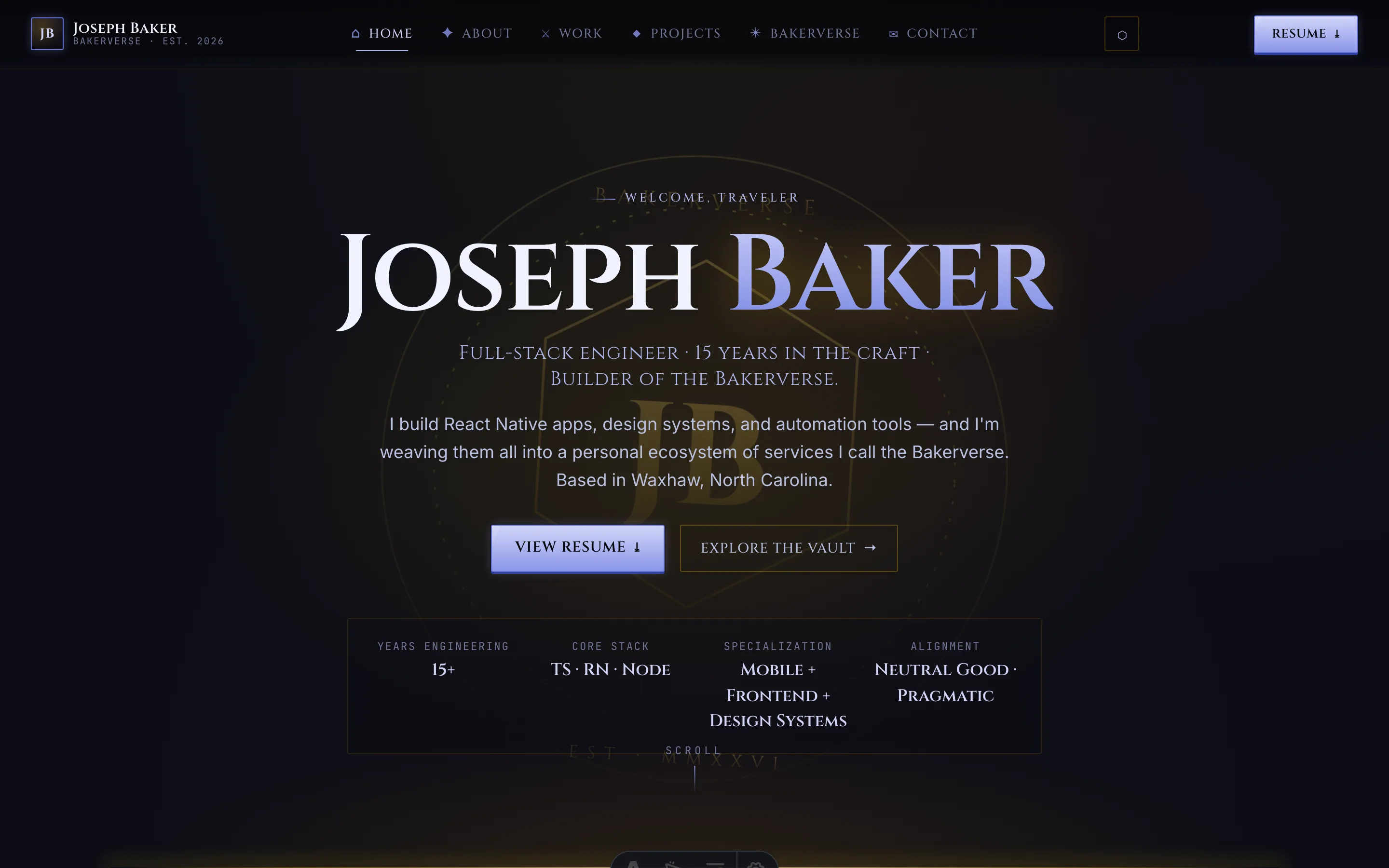
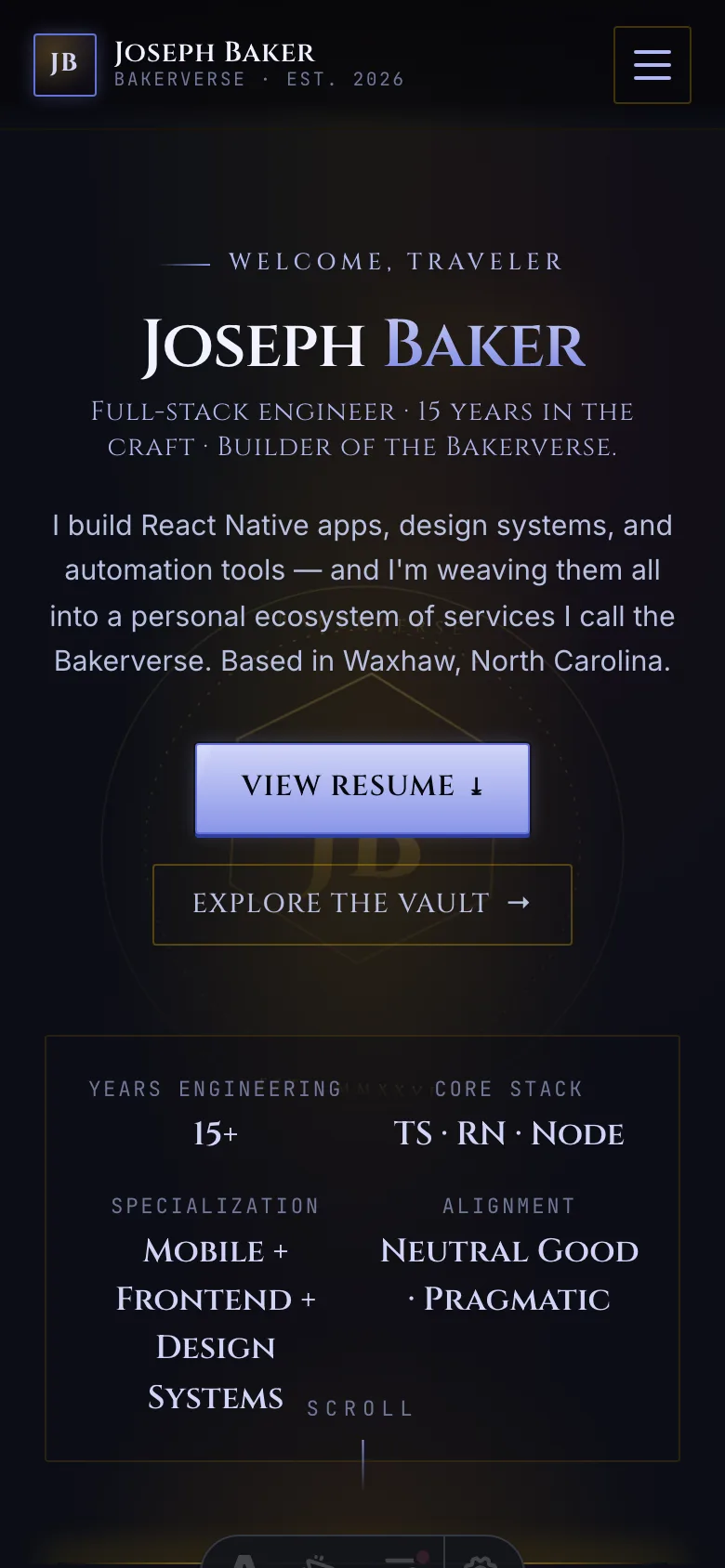
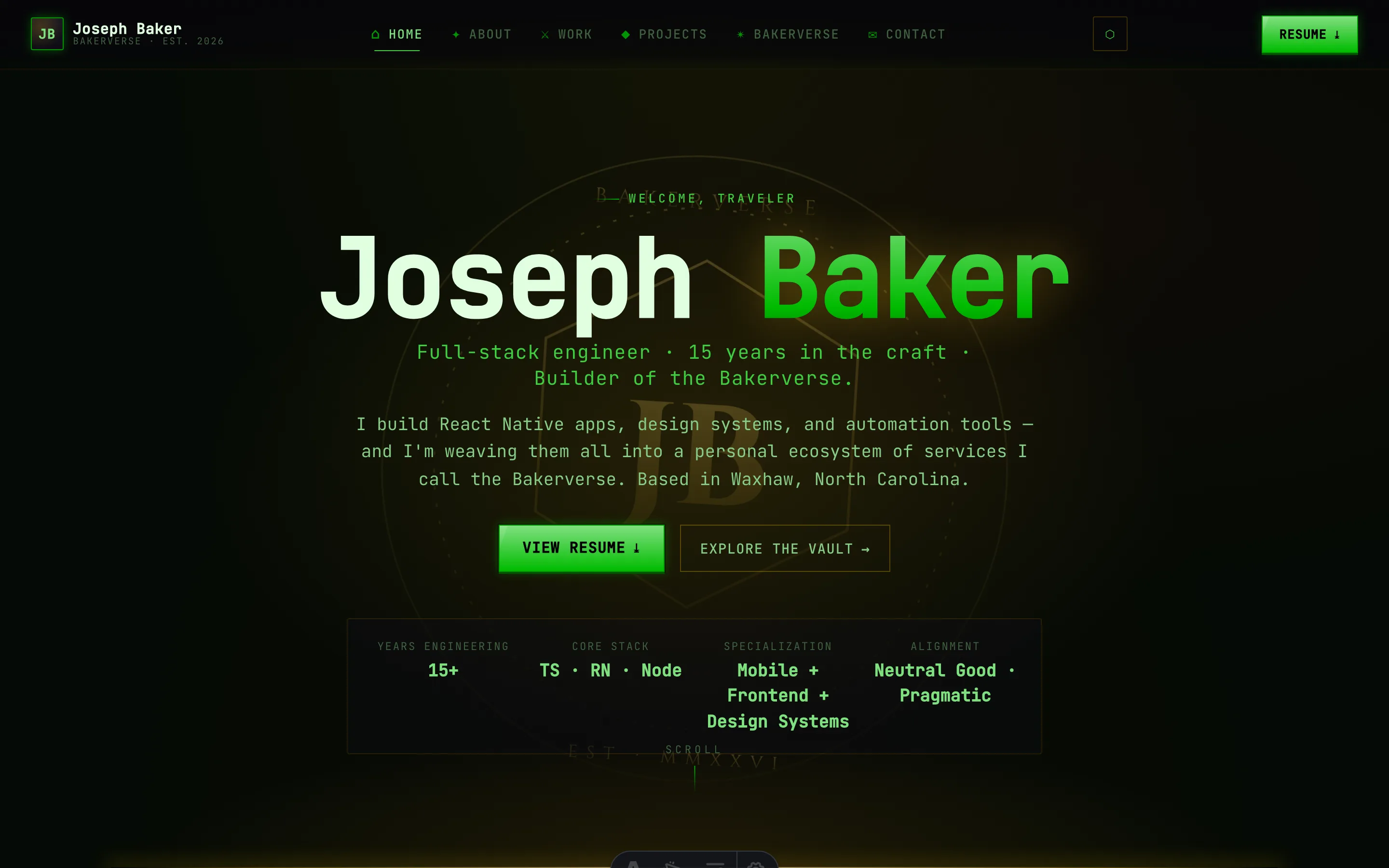
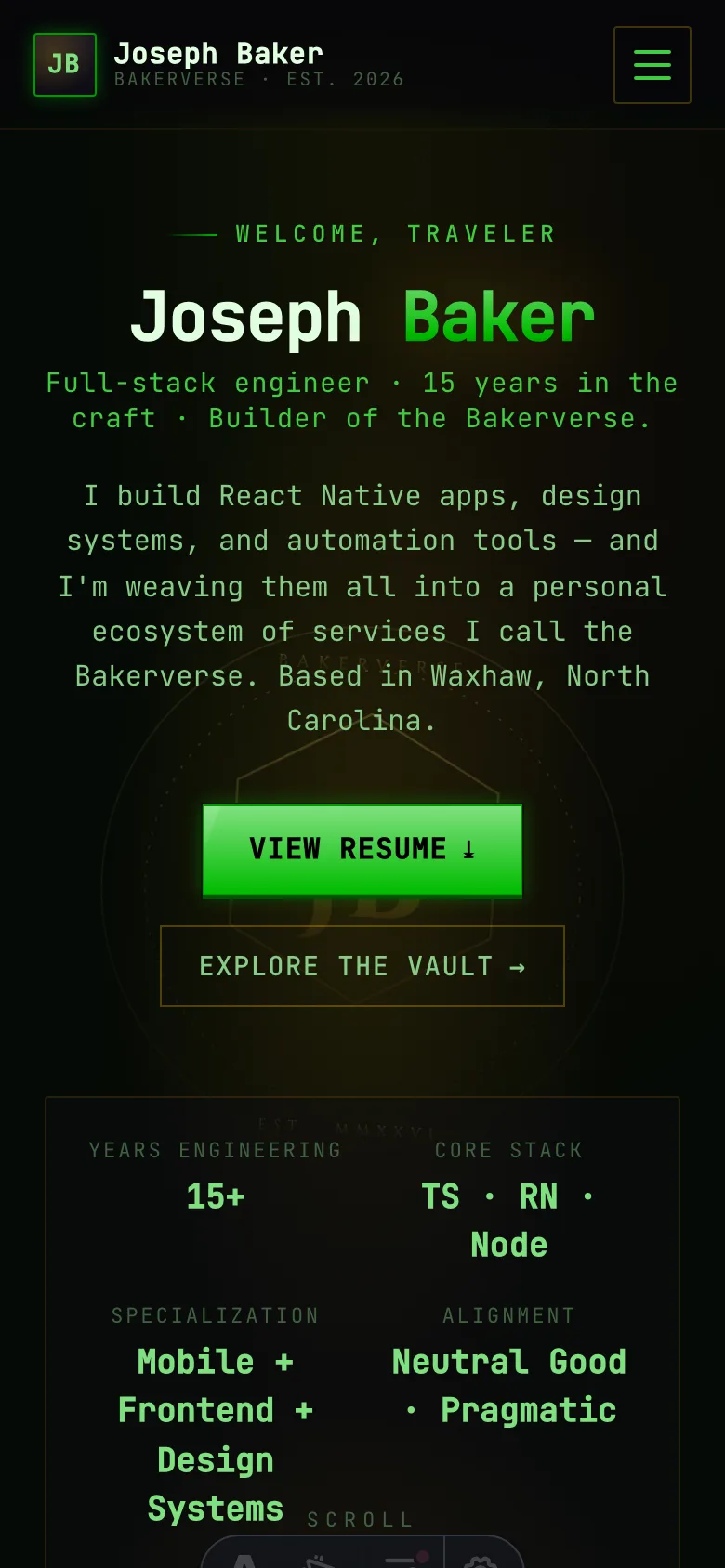
Every screenshot below is the same / hero rendered under a different
theme — zero component code changes, only the :root custom-property
values swap.
Diablo — the default
Arcane — starlight spellwork
Infernal — hellfire ember
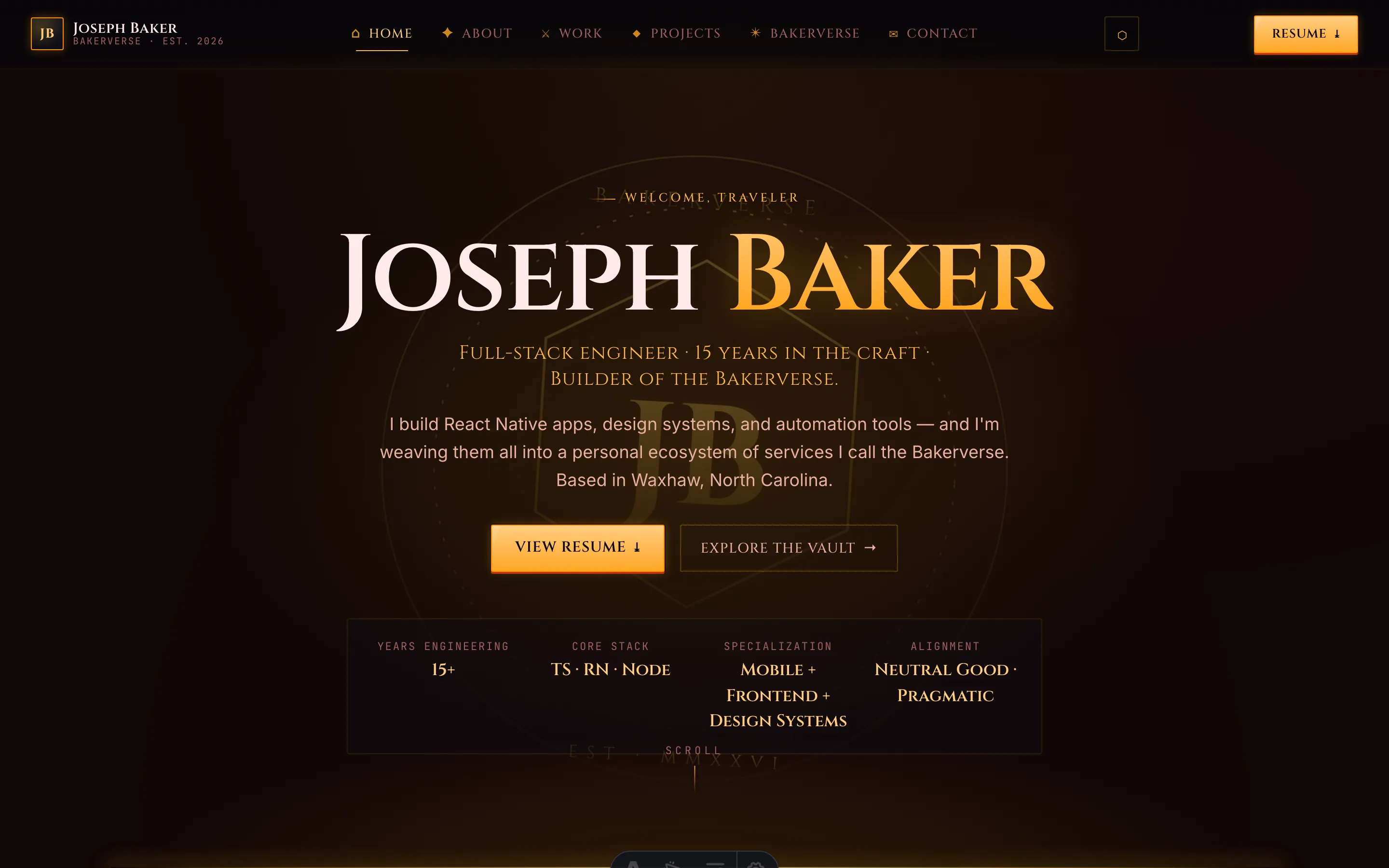
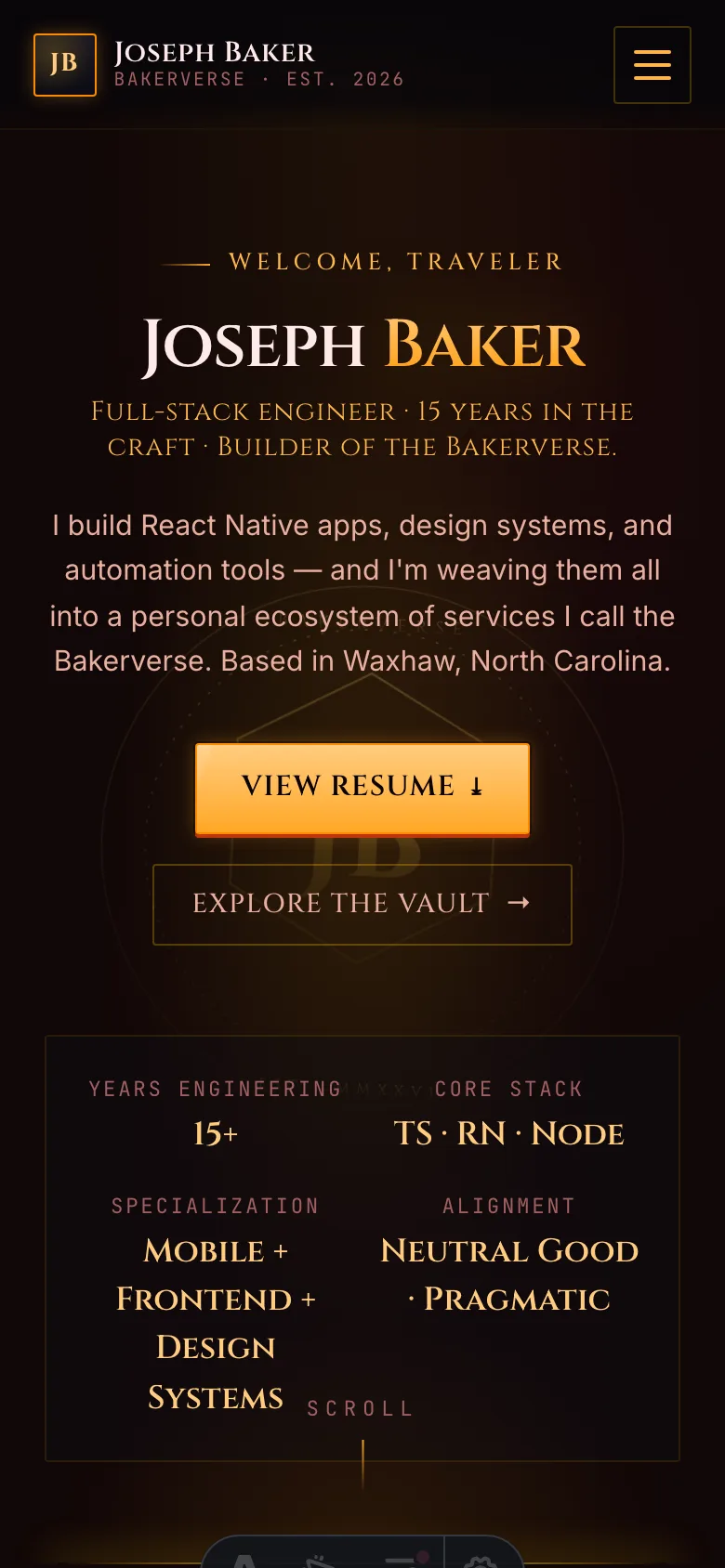
Celestial — moonlit vault
Terminal — hacker green
The outcome
Five fully distinct visual identities ship on josephkbaker.com with:
- Zero FOUC on hard reload, back/forward navigation, and View Transition routes across all five themes.
- WCAG AA contrast enforced at build time — a theme with insufficient
contrast ratio fails
pnpm buildwith a clear error message. - Live theme editor at
/playground/theme-editorwhere anyone can fork a base theme, tweak every token, preview in real time with contrast validation feedback, and share via a URL hash or download a TypeScript source file. - No new runtime dependencies — the entire engine is ~600 lines of TypeScript using only Node built-ins and the project’s existing stack.
The pattern — schema → validation → CSS emission → FOUC guard → store/apply — is reusable and decoupled enough that any Astro project could adopt it by swapping the theme definitions.